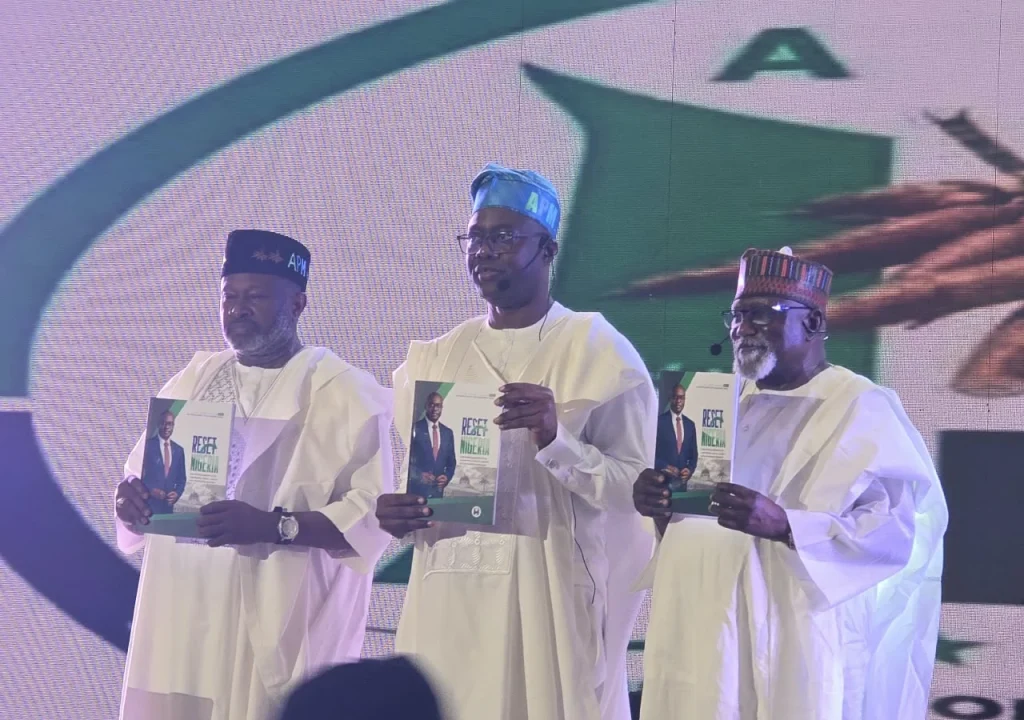
NIGERIA: Makinde-Daura Campaign Organisation unveils ‘Reset Nigeria’ manifesto 2027
By Grant Onyeke
He stated that the core proposition of his agenda was straightforward: that government must actively make life easier for the people by ensuring safety, decent living standards and accessible opportunities.
According to the presidential candidate, national policies must deliver tangible and verifiable results for all citizens.
Makinde stressed that broad-based economic growth should be directly translated into job creation, improved incomes and lower cost of living.
“Macro-economic stability must have a direct impact on the people,” he maintained, even as he cautioned against relying on short-term fixes.
Read Also:
-
NIGERIA: I’m not intimidated by Tinubu, Atiku, others- NRM Presidential Candidate
-
NIGERIA: NCS restates commitment to border management ahead of 2027 elections
-
Obidient Movement names Moses Paul National Coordinator, reassigns Tanko
The LeadWay Magazine reports that the Makinde-Daura Campaign Organization “Reset Nigeria Agenda” manifesto ahead of the 2027 presidential election. Grounded in lessons from Governor Seyi Makinde’s administration in Oyo State, the document outlines a citizen-centered approach structured around four primary pillars:
-
Resetting the Economy
-
Tax Philosophy: Focuses on taxing prosperity rather than poverty to relieve financial strain on low-income citizens.
-
Cost of Living: Aims to reduce the structural cost of living by lowering logistics, transportation, and energy expenses rather than relying solely on market price controls.
-
Trade & Enterprise: Simplifies interactions between businesses and government to reduce regulatory friction and positions Nigeria as a regional supply hub for neighboring markets.
-
-
Restructuring Security Architecture
-
Intelligence & Prevention: Prioritizes early warning systems and intelligence-led operations over reactive security responses.
-
Agency Coordination: Focuses on improving interoperability and communication between security agencies and local communities.
-
Institutional Accountability: Introduces systemic reviews of security incidents to identify operational failures and hold leadership accountable.
-
-
Reforming Education
-
Outcome-Based Metrics: Shifts focus from enrolment numbers to actual learning outcomes and relevant skill acquisition.
-
Out-of-School Children: Targets community-specific solutions to bring out-of-school children back into learning environments and retain them.
-
Workforce Alignment: Connects vocational and educational training directly to economic opportunities and job markets.
-
-
Resetting Socio-Political System & Governance
-
Fiscal Federalism & Devolution: Advocates for true federalism by granting state governments broader authority over security, natural resources, and regional affairs.
-
Institutional Strength: Emphasizes building strong, transparent public institutions rather than relying on individual political leaders (“strong institutions over strong men”).
-
Constitutional Compliance: Pledges strict adherence to constitutional standards, including seamless transmission of power during executive absences under Section 145.
-
These, according to the framework, include focusing macro-economic reforms on genuine broad-based economic growth that combats poverty and establishing strict state responsibility for results rather than making excuses for failure.
Others are building robust institutions capable of working across political and regional differences to foster national development and placing half of Nigeria’s population living in poverty at the centre of government decision-making, ensuring they are never treated as an afterthought.
Makinde explained that the manifesto was shaped by extensive consultations through listening to citizens across all of Nigeria’s six geo-political zones.
“Nigeria is rich in natural resources; Nigeria is rich in human resources, but our leaders are poor in ideas,” he stated.
The presidential candidate pledged that his administration’s outcomes would be fully measurable, with concrete progress evaluated within the first 100 days and across a three-year timeline in office.
In his remarks, the APM’s Vice-Presidential candidate, Alhaji Lawal Daura, emphasised that true democratic development required peace, security, prosperity and a level-playing field without suppressing the opposition.
Daura, who stressed that a healthy opposition was complementary to governance rather than an enemy, warned that using privileged positions to muzzle dissenting voices could harm the nation.
While reflecting on his entry into the political space, he said that Nigerian politics continued to be defined narrowly by cynicism and mistrust.
“I play politics, but I am not a politician,” he maintained.
Daura described their coalition as a sincere, authentic movement, driven by a genuine commitment to public welfare rather than personal or presidential interests.
He stated that their proposed administration in 2027 was envisioned as a transitional administration designed to bring all segments of Nigerian society together to openly discuss, debate and reach a collective resolution on the nation’s path forward.
The vice-presidential candidate urged Nigerians and the media to carefully examine their agenda, which, he said, centred on four foundational pillars; education, economy, security and socio-political system.
The national chairman of APM, Yusuf Dantalle, critiqued the current national conditions, noting that political parties were merely vehicles for attaining power to rescue Nigeria rather than ends in themselves.
Dantalle warned against any attempt to weaponise state institutions to undermine democracy or commit electoral fraud, which he described as the worst form of criminality, as it stripped citizens of their right to choose.
He urged electoral umpires to maintain strict integrity and work genuinely for Nigeria, emphasising that the younger generation was watching and expected a system that fostered peace, structural progress and true accountability.(NAN)

1 thought on “NIGERIA: Makinde-Daura Campaign Organisation unveils ‘Reset Nigeria’ manifesto 2027”