
China commissions 360-metre tower for high-altitude wind research
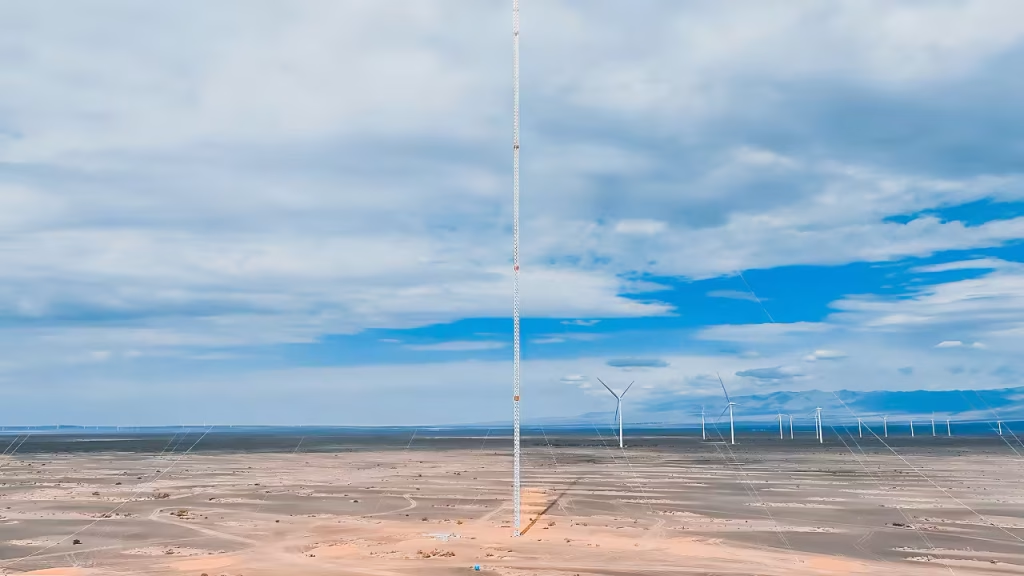
China has completed and put into operation a 360-metre wind-measurement tower in Mulei County, Xinjiang, making it the tallest completed wind-measurement tower in the global wind-power industry, according to Chinese state media. It was completed on September 17, 2026, at an 800 MW experimental wind farm.
TV BRICS, reported on Friday that the facility would support high-altitude wind energy observation and technical validation of wind energy standards.
The tower is located in a major wind and solar energy development zone and forms part of efforts to build large scale renewable energy bases in desert and desert grassland areas.
The structure is not itself a wind turbine. Its primary purpose is to collect detailed measurements of atmospheric conditions at different elevations.
Researchers will measure: wind speed and direction, wind shear — how wind speed changes with height, turbulence intensity, atmospheric stability, and other characteristics of the wind profile.
The data will be used to improve high-altitude wind-resource assessment, validate wind-measurement equipment and support the design of increasingly large wind turbines.
Why build a tower this tall?
The development is in line with China’s 14th Five-Year Plan, TV BRICS reported.
Modern wind turbines are becoming substantially larger, with hub heights and rotor diameters extending well above the traditional measurement ranges used in wind-resource assessments. Measuring the atmosphere up to 360 metres provides researchers with a much better picture of how wind behaves across the height range relevant to large turbines.
The tower is therefore essentially a large-scale scientific reference instrument. Researchers can compare different measurement technologies—including laser-based systems—with measurements taken at known heights, helping establish standards for wind-resource measurement.
Read Also:
-
Tesla Is Finally Unveiling the New Roadster Next Month — But You’ll Need $50K to Reserve One
-
Pawn Founder: I’m unlocking Africa’s untapped wealth through asset-backed finance
Part of a larger experimental platform
The tower sits within the 800 MW Mulei experimental wind farm, rather than operating as an isolated research installation. The site also contains facilities for observing turbine wakes and other wind characteristics.
China’s National Wind Power Standardization Technical Committee has designated the site as a wind-power standard technology verification base. The project has also brought together 11 wind-measurement equipment companies and six universities to conduct research and equipment testing.
Mulei lies in a region of Xinjiang with significant wind and solar resources. The county has been developing large renewable-energy bases and an associated industrial supply chain covering equipment such as turbines, blades, towers, photovoltaic components and energy-storage systems.
The location also makes sense scientifically: the surrounding Gobi environment provides a large, relatively open area in which researchers can study atmospheric wind profiles and turbine performance at scale.
China is also experimenting with wind above tower height. The 360-metre tower is particularly interesting because China is simultaneously researching airborne/high-altitude wind energy.
In September 2025, a team involving Tsinghua University and Beijing SAWES Energy Technology conducted field testing in Hami, Xinjiang, of a buoyant megawatt-scale high-altitude wind-energy system operating at about 1,500 metres. The tethered, helium-supported system carried 12 small turbine-generators and had a combined capacity above 1 MW.
That technology is fundamentally different from the Mulei tower: the tower is a measurement and validation facility, whereas the Hami project attempts to actually generate electricity from much higher-altitude winds.
The bigger significance
Taken together, these projects indicate that China’s wind-energy research is moving beyond simply installing more conventional turbines. There is increasing emphasis on understanding and exploiting the three-dimensional wind resource above the ground.
The 360-metre tower can provide the empirical data needed to answer questions such as:
How much stronger is the wind at 200–360 metres? How turbulent is it? How does wind shear affect very large rotors? How accurately can remote-sensing instruments measure those conditions? And can those measurements improve the economics and reliability of future giant turbines?
Those questions become increasingly important as turbine manufacturers pursue taller towers and larger rotors.
It is also worth distinguishing this project from China’s 1,500-metre airborne wind system: the former is a world-record measurement tower, while the latter is an experimental airborne power-generation system.



3 thoughts on “China commissions 360-metre tower for high-altitude wind research”